

RONALD REAGAN SIGNED THE KING HOLIDAY BILL, AND A BIPARTISAN CONGRESS VOTED TO OVERRIDE PRESIDENT REAGAN’S VETO OF THE COMPREHENSIVE SOUTH AFRICAN ANTI-APARTHEID ACT. I WAS THERE FOR BOTH.
 The time for D.C. Statehood is now. I gave a quarter of a century of my life as a staff person for Congress, and I can tell you, the environment for passing the King Holiday Bill, after years of trying, was comparable to today's environment. President Reagan repeatedly said Martin Luther King, Jr. was a Communist, and he would not sign the Bill. But he signed it.
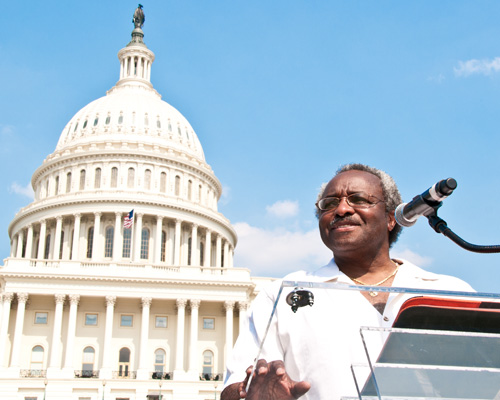
I was on the West Lawn of the Capitol when thousands gathered to hear Stevie Wonder sing that "Happy Birthday Song", and a little Black Boy, exhausted from marching, was captured in a photo that appeared on the Front Page of the Washington Post, upper fold, where he sat on the curb, chin in hand, with a simple sign, "Pass the Bill".
I was there when Pug Ravenel, a Member of Congress from a distinguished Political Family in South Carolina expressed support for the South Africa Bill, notwithstanding President Reagan's position that an Executive Order would be best to handle a situation where four percent (4%) of the population owned, controlled the land and voted over ninety-six (96%) percent of Black South Africans, and a Bipartisan Congress voted to override his Veto of the Bill to correct that situation.
I want to be there when a Bipartisan Congress passes H.R. 51, the D.C. Statehood Bill. The time is now. The environment is set.
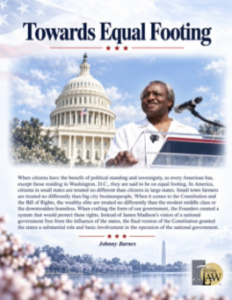
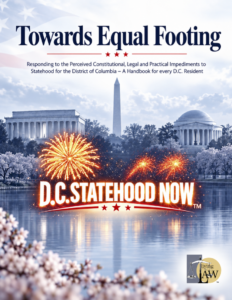
Thirty Million Americans visit Washington, D.C. each year. The condensed Booklet I am about to release will be presented in three parts, and if every D.C. resident reads and studies it, it will allow each to be able to contribute to the education of those visitors as well as friends and relatives from the states. Those visitors and your friends and relatives will then be equipped to debunk and disprove the bad information and misinformation that opponents of D.C. Statehood rely upon to deny the people of the District of Columbia the same rights that all other Americans take for granted. Read this Booklet, the first of three parts. Study this Booklet. Do so, and D.C. Statehood is within our reach, NOW!
Throughout the muddied history of the District of Columbia, this relationship has been marked by false promises, mounting legal complications, and the unwillingness of the courts, to date, to provide the rights that our citizens deserve. This relationship, unique throughout the world, is a classic “chicken and egg” dilemma. If District residents had political standing and sovereignty, we could have senators, representatives, and local autonomy. If we had senators, representatives, and local autonomy, we could have political standing and sovereignty. The challenge, however, is how to initiate this cycle, because currently, the District of Columbia has neither chicken nor egg. As an Assistant Attorney General for the United States, former Supreme Court Chief Justice William Rehnquist, a Republican, stated, “The need for an amendment [providing representation for the District of Columbia] at this late date in our history is too self-evident for further elaboration; continued denial of voting representation from the District of Columbia can no longer be justified.” Unfortunately, the promissory note that Rehnquist once issued has never been collected. This abandoned promise of the United States still persists as the greatest stain on this country, and now is the time, more than ever before, when we should insist that this promise be fulfilled."
I shall give away, free, a limited number of this easy to study booklet, on 25 October, and will present a forum for those who wish to receive it. If our presumed next Congressman, current Council member Robert White, is available, whose energy, vision and drive on this subject is today, without comparison, he is free to speak, whenever he arrives. I learned that in my 25 years, working on the Hill.
There will be limited seating, so follow this Post, beginning October 1st, for the time and place of the Forum.
I learned in college that, "The first stage of revolution (change) is revolution of the mind".
"Freedom ain't free".
This Booklet, I believe, will help us conclude this Journey of a thousand miles.